
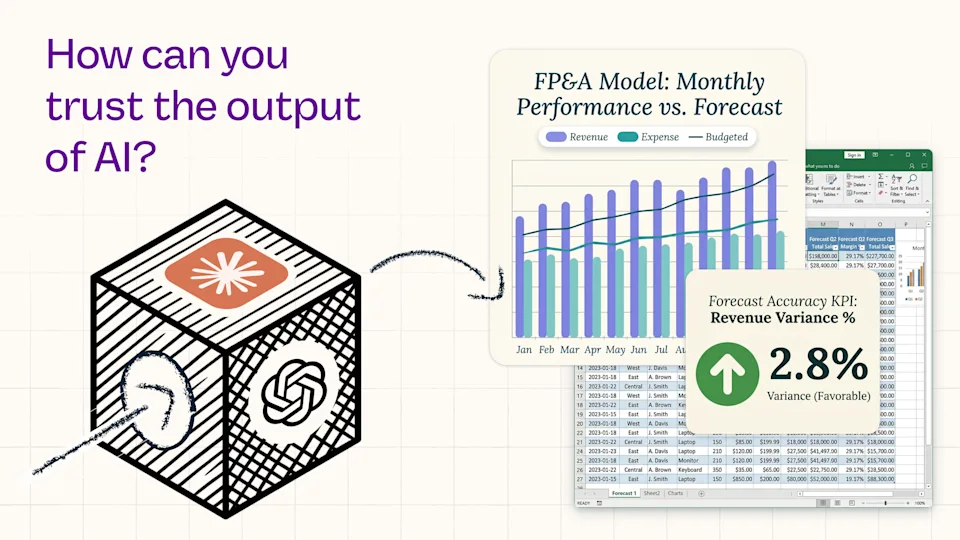
AI is rapidly changing how finance teams work. Tasks that once took hours can now be completed in minutes, from generating spreadsheet formulas and financial summaries to creating forecasts and scenario models.
For finance teams under pressure to move faster, the appeal is obvious. But as AI becomes more embedded in planning and modelling workflows, a more important question is emerging: can you trust the output?
Speed is not the same as confidence
The conversation around AI often focuses on speed and efficiency, and rightly so. However, finance teams are not judged on how quickly they build a model. They are judged on whether the numbers support good decisions. Generating a financial model is not the same as understanding a business.
Modern AI tools can now create sophisticated spreadsheets and calculations in seconds. Yet finance teams still face the same challenge they always have: does the model accurately represent how the business actually operates?
For decades, spreadsheets have been the default planning tool. They are flexible, familiar and easy to adapt. However, businesses do not operate in rows and columns. They operate through products, customers, employees, supply chains, warehouses and operational processes. Spreadsheets simplify that complexity into disconnected formulas and assumptions.
The hidden risk of AI adoption
There is also another layer of trust that finance leaders need to consider: what happens to the data being uploaded into AI tools.
As organisations increasingly experiment with AI for forecasting, modelling and reporting, finance professionals need to understand not only whether the output is accurate, but also how their information is being processed behind the scenes. Uploading confidential financial data into AI platforms without appropriate safeguards could create governance, compliance and security risks. Understanding data retention policies, processing rules and internal AI governance is becoming just as important as understanding the technology itself.
Why finance teams are looking beyond spreadsheets
The challenge is reflected in Kaleidoscope's State of Financial Modelling & Planning 2026 report. The research found that 42% of finance teams still rely exclusively on spreadsheets, while 45% spend significant time manually updating data and 44% spend major time checking for errors. At the same time, 72% expressed interest in adopting more specialised modelling tools.
AI can generate thousands of formulas almost instantly, but it does not automatically solve the structural weaknesses underneath a model. Many organisations still rely on disconnected spreadsheets and simplistic assumptions when planning for the future. Traditional "best case" and "worst case" forecasts often fail to capture the complexity of real business decisions.
Consider a new product launch. The impact extends far beyond projected sales. Inventory requirements, warehouse capacity, marketing budgets, production schedules, supplier lead times, staffing and financing all become interconnected. A delay in one area can create consequences elsewhere. Effective planning requires these relationships to be modelled together.
The challenge of validating AI-generated models
This is where AI can provide significant value, but also where the risks become more apparent. An AI-generated model may look convincing and calculate correctly, but finance leaders still need confidence that the assumptions and relationships underneath genuinely reflect operational reality. That trust matters because FP&A is fundamentally about enabling decisions.
Finance teams are increasingly expected to help leadership evaluate risk, assess trade-offs and model future outcomes before resources are committed. That role becomes much harder when planning systems are fragmented across spreadsheets, disconnected data sources and manually maintained assumptions.
This is why AI adoption remains both exciting and challenging. Most finance professionals can already see the productivity benefits. AI can help clean data, generate reports, identify anomalies and accelerate modelling workflows. Those capabilities will continue to improve.
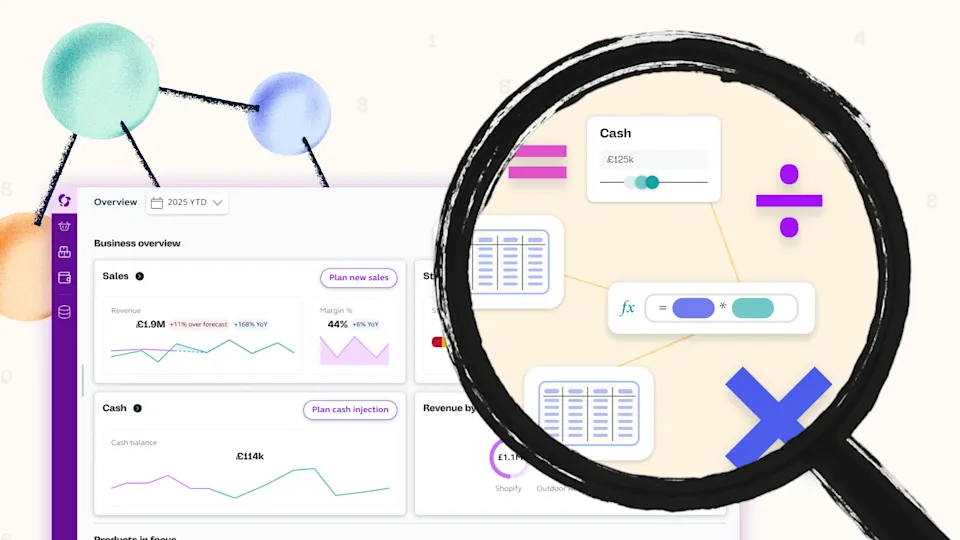
However, questions around visibility and control remain. If an AI tool generates a complex model containing thousands of formulas, how can a finance team validate it? How easily can someone trace the logic behind the numbers? How quickly can flawed assumptions be identified?
Building the future of financial planning
As businesses move faster and decision-making windows shrink, these questions become increasingly important.
The finance teams that gain the greatest advantage from AI will not necessarily be the ones using the most tools. They will be the ones building planning environments that remain transparent, connected and grounded in how the business actually works.
Planning is no longer simply a reporting exercise. Organisations are operating in increasingly volatile environments where pricing, inventory, hiring, investment and forecasting decisions can change quickly. Finance teams need systems that allow them to evaluate scenarios dynamically rather than react after problems emerge.
That means moving beyond disconnected spreadsheets and static forecasts towards planning models that reflect operational relationships in real time. AI can accelerate outputs, but confidence still depends on the quality, transparency and structure of the underlying planning environment.
Trust remains the foundation
Finance professionals should not ignore AI. In fact, understanding AI may become one of the most important technical skills the profession develops over the coming years. The challenge is ensuring adoption happens alongside strong governance, transparency and planning discipline. Because ultimately, trust remains the foundation of financial planning.