skip to content

Planning isn’t a set of separate jobs. It’s one connected system.

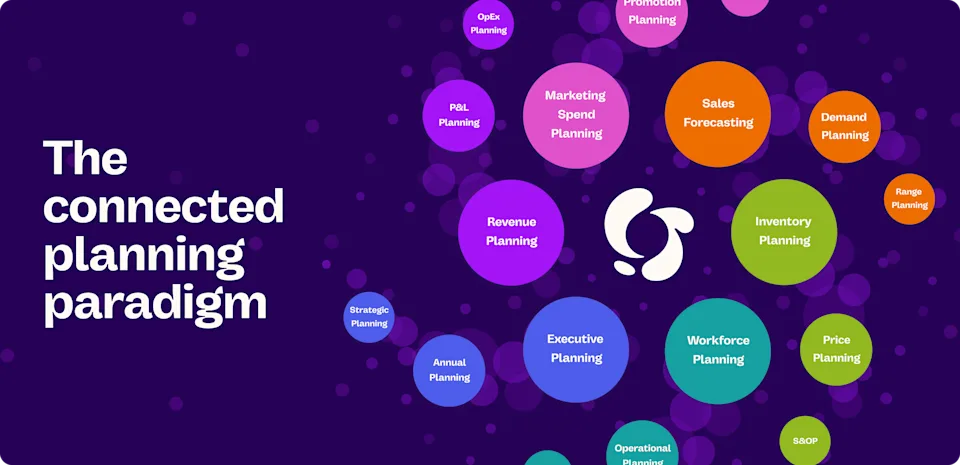
The connected planning paradigm

Most teams don’t mean to plan in silos — it just happens. Forecasting lives in spreadsheets. Inventory decisions are made under pressure or gut feel. Finance lags behind reality. Strategy becomes a deck, not a plan.

The result is familiar: you optimise one area, only to create problems somewhere else.

Connected planning fixes this by making each model feed the next — automatically, continuously, and transparently. Every decision is grounded in the reality it creates downstream.

How Kaleidoscope makes connected planning a reality

At its core, Kaleidoscope links your business plans into one system.

  • Each model produces outputs the next depends on — and each improves as more of the system is in place.

  • Share the same underlying data, assumptions, and scenarios — not disconnected tools or exports.

  • Changes in one place flow through the rest of the plan automatically.

Below is how the system fits together:

Sales analysis

Platform Sales Analysis

Understand what’s happening — and why

Sales analysis turns raw performance data into usable signals: what’s growing, what’s slowing, what’s seasonal, and what’s noise.

It answers: What’s really driving performance across products, channels, and time?

It produces:

  • Performance drivers and trends

  • Seasonality signals

  • SKU and category insights

It feeds into: Demand forecasting and range planning — by grounding assumptions in reality.

Demand & stock forecasting

Translate insight into a forward-looking plan

Forecasting uses sales insight, inventory data and business context to build a realistic view of future demand — and what stock you’ll need to support it.

It answers: What will customers want, when, and in what volume?

It produces:

  • Demand plans by SKU and time period

  • Stock targets and risk signals

  • Expected stockouts and overstocks

It feeds into: Inventory planning and financial planning — by defining what the plan actually requires.

Inventory planning

Turn the plan into buying decisions

Inventory planning converts forecasts into concrete actions: what to reorder, when, and how much — while balancing availability, cash, and risk.

It answers: What stock decisions do we need to make to support the plan?

It produces:

  • Purchase and replenishment plans

  • Inbound schedules

  • Coverage and reorder logic

It feeds into: Financial planning and strategic planning — by committing cash and capacity.

Financial planning

Understand the financial impact of the plan

Financial planning shows what your operational decisions mean for cash, margin, and runway — before reality hits.

It answers: Can we afford this plan, and what trade-offs does it create?

It produces:

  • Cashflow expectations

  • Margin and profitability impact

  • Scenario outcomes

It feeds into: Strategic planning and range decisions — by clarifying constraints and options.

Strategic planning

Decide what you’re optimising for

Strategy sets direction: growth vs cash, margin vs availability, focus vs expansion. In Kaleidoscope, strategy isn’t separate — it directly shapes the plan.

It answers: What matters most right now, and what are we willing to trade off?

It produces:

  • Clear priorities and targets

  • Constraints and guardrails

  • Scenario-based decisions

It feeds into: Range planning and forecasting assumptions — by aligning execution to intent.

Range planning

Range Planner UI

Choose what you sell — and what you stop selling

Range planning defines the products you back, the ones you exit, and how your assortment evolves over time.

It answers: What should be in the range, and how should it change?

It produces:

  • Assortment and SKU lifecycle decisions

  • Newness vs core balance

  • Category and product focus

It feeds into: Forecasting, inventory planning, and sales analysis — closing the loop.

Working in isolation means plans break

You can tackle any one of these in isolation. Most teams do. But without connection, planning quality drops fast.

Connected planning avoids these traps by design. Whether you start with a stock problem, a cash question, or a growth target, Kaleidoscope connects the rest of the planning loop automatically — so every decision improves the next one.

Financial planning without inventory context

hides operational risk

Forecasting without range planning

forecasts products you haven’t committed to

Inventory planning without forecasting

optimises replenishment against weak demand signals

Strategy without execution planning

stays aspirational

Sales analysis without downstream planning

creates insight with no impact

Start your connected planning journey

With Kaleidoscope, you can model your business as a connected system and see the impact of change instantly across every plan and scenario. When everything is connected, decisions become easier and more confident.

Sign up for Early Access

In the run up to our commercial launch, we're working with small group of early access customers. Early access gives businesses access to our ready-to-use Sales and Stock model templates today. Apply your place on the early access program, or join our waitlist to be notified about our full launch.