
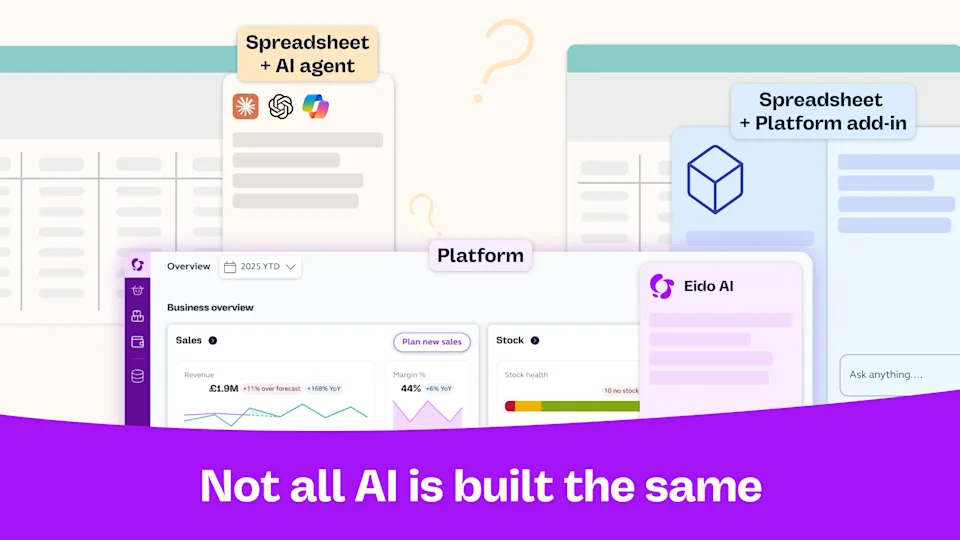
AI has arrived in finance. The question is no longer whether to use it, it's which version of it is actually worth your time.
For finance leads at growing businesses, the options can feel overwhelming. Every platform claims to be AI-powered. Every vendor promises faster forecasts, fewer errors, and models that practically build themselves. The reality is more nuanced.
There are three distinct ways finance teams are integrating AI into their financial modelling workflows right now. They are not interchangeable. Each one solves a different problem, suits a different stage of business, comes with its own limitations, and carries a very different price tag and level of accuracy. Understanding the difference is the starting point for making a decision that actually moves things forward.
This guide breaks down each approach. What it is, when it makes sense, and where it falls short — and where the risks are. It ends with a framework for choosing the right one for your business.
The approach you take determines whether AI genuinely improves the reliability of your financial model or just adds a layer of complexity on top of an existing problem. And with costs ranging from near-zero to six figures depending on the route, getting this decision right matters.
The three routes
Most finance teams at growing businesses are running on models they have built and maintained themselves in spreadsheets. Those models are valuable, as they encode years of institutional knowledge about how the business works. But they are also fragile. Logic lives in individual cells. When the business changes, the model requires manual surgery. When multiple people are involved, version control becomes a problem. When the model grows, performance degrades.
AI promises to solve this. In the routes below we will explore the benefits and what to watch out for.
Route 1: In your spreadsheet, with an LLM assistant
What it is
An AI assistant such as Copilot in Excel, Claude or ChatGPT on a second screen, or a similar tool — used alongside your existing spreadsheet model. The AI helps write formulas, explain outputs, generate scenarios, and answer questions about the model in plain English.
What it costs
This is the lowest-cost route by a significant margin. Microsoft Copilot is included in many existing Microsoft 365 business subscriptions, making the marginal cost close to zero for teams already paying for Office. Standalone tools like ChatGPT start at a few pounds per user per month. There are no implementation costs, no onboarding process, and no long-term commitment. You can start tomorrow.
When it makes sense
If your primary frustration is speed. If building formulas takes too long, explaining outputs to stakeholders is time-consuming, generating scenarios manually is a bottleneck — an LLM assistant addresses those friction points directly. For teams that are not ready to invest in a dedicated platform, it is a low-cost, low-commitment way to get more from the tools they already use.
Where it breaks down
The fundamental limitation is verification. When an LLM generates a formula or suggests a change to your model, it does not validate that output against your model's structure. It does not flag when the logic is unsound. It gives you an answer and it is your job to check it.
LLMs are inherently probabilistic. This means they are prone to hallucinations. You can't expect AI to deliver you an output with 100% accuracy. Therefore outputs need to be checked, regularly.
There is also an inconsistency problem. Ask the same question twice and you may get a different answer. For a financial model that needs to be reliable and auditable, that is a significant concern.
In practice, the time saved generating outputs is often spent checking them. The speed gain is real but smaller than it appears. More critically, the structural problems with the underlying spreadsheet model are unchanged. The model is still cell-based, still fragile, still prone to silent errors as it grows.
There is also the risk of uploading confidential financial data into standalone LLM platforms without the appropriate safeguards in place. Read more on this at the end of this article.
The verdict
Route 1 is a short-term productivity improvement, not a modelling improvement. The low cost makes it an easy experiment but easy to start does not mean effective at scale. For teams with simple, stable models and a primary need for speed, it is a reasonable short-term solution. For teams building complex models on which business decisions depend, the low price tag comes with a hidden cost: the time your finance lead spends checking outputs, fixing errors, and maintaining a model that was never designed to scale.
Route 2: In a platform connected to your spreadsheet
What it is
A dedicated FP&A or planning platform that connects to your existing spreadsheet data via an integration, add-in, or model protocol. The interface changes; you are working in a purpose-built tool rather than directly in Excel but the underlying data often still lives in or connects back to your spreadsheets.
Examples include Excel-native platforms that layer planning and reporting workflows on top of existing spreadsheet models, and tools that use model protocols to give an AI assistant direct access to your data.
What it costs
Route 2 sits in the mid-range. Most platforms in this category are priced on a per-seat or per-module basis, typically running from a few hundred to a few thousand pounds per month for a finance team at a growing business. Implementation and onboarding costs vary, while some platforms are self-serve, others require a setup process that adds to the initial investment. Expect a longer commitment than Route 1, with annual contracts common.
When it makes sense
If your team needs better reporting, cleaner workflows, or the ability to share models across the business without the version control chaos of emailing spreadsheet files, a platform in this category represents a meaningful improvement. The workflow benefits are real. Data consolidation, real-time reporting, and structured collaboration are all easier in a dedicated tool than in a spreadsheet.
Where it breaks down
The critical question for any platform in this category is what the AI actually understands about your model — not just what it can access.
Connecting an AI to your spreadsheet data via an integration or model protocol means it can read your numbers and respond to questions about them. It does not mean the AI understands the logic behind those numbers, nor what they represent, how they relate to each other, or whether the structure is sound. And there can be a big difference between generating a plausible reason for what you're seeing and the human intent in the design.
If you change something fundamental about how your business operates, the question is whether the model reflects it automatically or whether someone still has to go in and manually update every touchpoint in the underlying spreadsheet logic. For most platforms in this category, the answer is the latter.
The verdict
Route 2 is a significant step forward in terms of workflow and accessibility, and the pricing reflects that. But higher cost does not automatically mean the structural problem is solved. The interface is better. The logic layer underneath may not be. The key test before committing: does the AI understand your model, or just your data?
Route 3: Native in an FP&A platform
What it is
A platform built from the ground up for financial planning and analysis, where the model lives in the platform rather than in a spreadsheet. The AI is embedded throughout — not as an assistant bolted on top, but as a core part of how the model is built, interrogated, and maintained.
What it costs
Historically, this has been the enterprise tier — and for the established players, it still is. Platforms like Anaplan, Pigment, and Adaptive Planning are priced for large organisations, with implementation projects that can run into six figures before you have built a single model. For a finance lead at a SMB business, that pricing has traditionally put Route 3 out of reach.
That is changing. Kaleidoscope's new generation of AI-native platform is being built specifically for growing businesses — with the rigour of enterprise calculation engine at a price point that reflects the size of the team using it, not the ambitions of a procurement department.
When it makes sense
For finance leads who have outgrown manual maintenance and need a model that can scale with the business, an AI-native platform is the right direction. The workflow is faster, the model is more robust, and the AI can genuinely reduce the time spent on maintenance and scenario building.
Where it breaks down and what to look for
Not all AI-native platforms are built the same way. The distinction that matters most is whether the AI was designed specifically for financial modelling or adapted from a general-purpose language model.
A general-purpose AI can fluently generate outputs that are structured like typical financial models. It cannot reliably sanity-check those outputs against your specific model. It does not have financial modelling best practice built in. It was trained on everything, which in practice means it has deep expertise in nothing.
There's a difference between content and structure, the latter is about how it looks whereas the former is whether it actually makes sense.
A platform built on a purpose-designed calculation engine, where the AI understands the structure of the model, validates its own suggestions before surfacing them, and has modelling expertise embedded from the ground up — solves the problem that every other route leaves open.
Even more, if it can move beyond structure, to content.
The questions worth asking any AI-native platform:
Does the AI validate what it suggests, or just generate it?
When the business changes, how does the model update? Is it robust? Can you track it?
Can you see why the numbers say what they say, at every stage?
Is the AI built on financial modelling expertise, or a general-purpose model pointed at finance data?
The verdict
Route 3 is the right destination for most finance teams at growing businesses. The historical barrier has been cost and implementation but that barrier is lower than it used to be. One built on a general-purpose LLM is Route 1 with a better interface and a higher invoice. An AI-native platform built on a purpose-designed calculation engine solves the structural problem.
How the three routes compare
Route 1 | Route 2 | Route 3 | |
|---|---|---|---|
Where you work | Spreadsheet | Platform + spreadsheet data | Dedicated platform |
AI involvement | LLM assistant | Connected AI | Embedded AI |
Typical cost | Near zero | Mid-range | Historically high; changing |
Speed improvement | Moderate | Moderate–high | High |
Structural improvement | None | Partial | High (if purpose-built) |
AI validates outputs | No | Rarely | Yes (if purpose-built) |
Model adapts to business change | Manual | Partially manual | Automatic (if purpose-built) |
Modelling best practice built in | No | Rarely | Yes (if purpose-built) |
Right for | Teams needing quick speed gains | Teams needing better workflow | Teams needing structural rigour |
The hidden risk of AI adoption
For lean SMB finance teams, AI tools feel like a superpower for scaling daily output without increasing headcount. However, uploading confidential financial data into AI platforms without appropriate safeguards creates massive governance, compliance, and security risks. When you are the entire finance department, internal AI governance is just as important as understanding the technology itself.
How to safeguard against the risks:
Data control & privacy
Set clear boundaries: Deploy a simple, one-page internal policy defining exactly what financial data can be pasted into public AI tools.
Lock down vendor terms: Verify that your AI vendor uses enterprise-grade privacy settings so your corporate financial data isn't used to train public models.
Limit third-party access: Enforce strict controls over which accounts can share financial data with external apps, and ensure integrations are granted minimum permissions only.
Calculation integrity
Keep calculations grounded: Never allow Large Language Models (LLMs) to act as the primary system of record for financial figures; use AI to write formulas, but let Excel or your accounting engine run the calculations.
Sanity-check every output: Don't treat AI-generated figures as final. Spot-check formulas, test edge cases, and ensure every number traces back to a verified source.
Platform due diligence
Understand your platform's compliance posture: Check whether the tools you're using are SOC 2 certified and GDPR compliant before feeding sensitive financial data into them.
How to choose the right approach for your business
The right route depends on where your model is today, what problem you are actually trying to solve, and what investment makes sense right now.
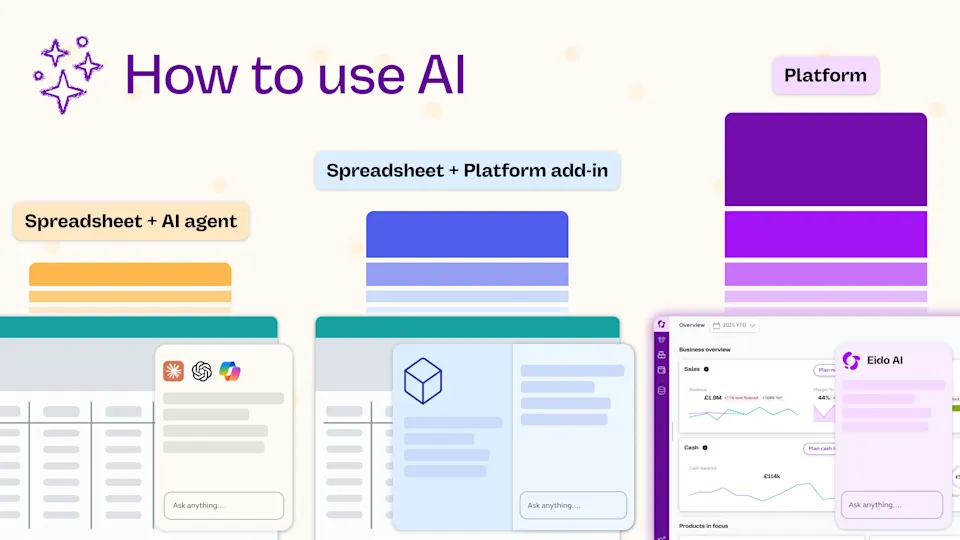
If your model is stable and your main frustration is speed, Route 1 is a reasonable short-term move. The near-zero cost makes it easy to start. An LLM assistant will reduce friction on formula writing and scenario generation without requiring a platform decision. Just be clear-eyed about what it does not solve. And ensure you check its work.
If your model is becoming harder to maintain as the business grows, Route 1 is not enough and the hidden cost of a finance lead spending hours checking AI outputs and manually maintaining a fragile model adds up faster than a platform subscription. Routes 2 or 3 are the right direction.
If you need better workflow and reporting but your model logic is sound, Route 2 may be the right intermediate step. A platform that connects to your existing data improves how it is accessed and shared and the mid-range pricing reflects a meaningful improvement in capability.
If you need a model that can scale with the business, adapt to change, and be relied upon for real decisions, Route 3 is where you need to be. The enterprise pricing of the established players has historically made this feel out of reach for growing businesses but it is worth investigating what is now available at your scale before assuming it is.
The three questions that cut through the noise, on capability and on cost:
Does the AI validate what it suggests, or just generate it?
When the business changes, does the platform do to the work of updating the model or do you?
What is the real cost of getting this wrong — in your finance lead's time, and in the decisions made on unreliable numbers?
If any platform you are evaluating cannot answer the first two clearly, the answer to the third becomes a lot more expensive.
Want to see how Kaleidoscope compares to spreadsheets? See how we compare →